
At IntelliSport, we seek inspiration from those who share our perspective on how sports leaders should think and act. Today, we draw from researchers of college athletics, a philosopher who studies how social structures shape what we value, and arguably the greatest coach in college football history.
A core belief that kick-started the founding of IntelliSport: there is too often a misalignment between purpose and values within sport. But for the sake of level setting the conversation, let’s first explore a few definitions, and the convergence and divergence of these ideas.
Values in Sport: Values are the qualities, standards, and goods that athletes, coaches, and organizations hold as worthy of pursuit—both within the practice of sport itself and in the broader life context that surrounds it.
Purpose in Sport: Purpose is the overarching reason or aim that gives meaning to one's engagement with sport—the answer to why an individual or organization participates at all.
Purpose, then, is the meta-level orientation that determines how one relates to sport's values. Two athletes can share identical values (excellence, discipline, teamwork) while holding radically different purposes; one using sport primarily for external reward, while another finds intrinsic meaning in the practice itself.
What we find worrisome at IntelliSport are leaders unaware of these distinctions, and the consequences: misalignment between espoused values and operational purpose, or lacking the agency to realign when they drift apart. So, let’s unpack this disconnection between values and purpose, by considering, yes — college athletics mission statements.
Missions statements play an important role for organizations because they signal what to value and how people should act within an organization. However, if you have spent any time within an organization, inevitably there is, or there is at the very least a perception that actions and mission statements do not align.
Researcher Russel Ward in a study of 343 Division I athletic departments found something striking: despite varying levels of achievement in graduating student-athletes, ensuring gender equity, or adhering to NCAA rules, these departments use remarkably similar organizational language. High performers don't signal their distinguishing values through their mission statements. The link between stated mission and actual outcomes remains unclear.
This suggests many leaders haven't considered how to connect the values they hold—team excellence, athlete development, graduation rates—with their why. Why do athletes, coaches, administrators, and staff grind daily as part of the machine that is college sports?
The work of C. Thi Nguyen offers a perspective as to why we have lost meaningful connection between our values and purpose.
It may be strange to introduce a philosopher to explain sport, but the work of C. Thi Nguyen helps us to understand the gamified systems we all live in, and how we’ve been desensitized to these constructs.
Nguyen developed the concept of value capture to describe how institutions and quantified systems hijack our values. When we adopt simplified metrics—grades, likes, rankings, win percentages—as proxies for complex goods like learning, connection, or excellence, those metrics can gradually replace the original values in our motivational structure. We optimize for the number rather than what it was meant to represent.
In a conversation on Pablo Torre Finds Out, Nguyen explains how value capture impacts our day-to-day lives:
"What we are doing here is shaping people. That's what's going on with a lot of metrics. What I am worried about is some external institution sets a metric and then we take that on as a target. I call this 'value capture.' When you have a rich value and you are exposed to it and you internalize it... you are handing over your values for metrics."
Torre captured the consequence:
"You realize all you're doing is abandoning that deeper and richer and more subtle thing you actually enjoyed for the thing that helps you compete at a game that doesn't actually make you feel better or more fulfilled."

In short - the question for sports leaders is: have we traded metrics and outcomes at the expense of the beauty of the process—the struggle and appreciation for why we engage in sports as athletes, coaches, or administrators?
A Framework: Intrinsic vs. Instrumental Values
Nguyen's work helps distinguish two types of values in sport:
Intrinsic values emerge from the activity itself—the beauty of coordinated movement, the satisfaction of mastering a difficult skill, the experience of flow in competition.
Instrumental values attach to sport's external goods—health, income, status, scholarship opportunities. These aren't inherently problematic, but they create conditions for value capture: when easily quantifiable metrics gradually colonize and replace harder-to-measure values like integrity, development, or communal belonging.
This is where a fundamental misalignment occurs; when there is a lack of awareness between these value types. A coach might genuinely value athlete growth, but if organizational incentives only measure win-loss records, the simpler metric can slowly displace the complex value it was meant to represent.
Achievement Play vs. Striving Play
When it comes to purpose, we have to consider why an individual or organization participates at all. Nguyen's distinction between achievement play and striving play clarifies purpose.
In achievement play, the purpose is winning or accomplishing the external goal. The game is a means to an end.
In striving play, the purpose is the experience of agency itself—the harmonious struggle against obstacles, the temporary adoption of goals that create meaningful challenges. Winning matters within the game precisely because caring about it makes the striving worthwhile, but the deeper purpose transcends the outcome.
Purpose, then, is the meta-level orientation that determines how one relates to sport's values. Two athletes can share identical values (excellence, discipline, teamwork) while holding radically different purposes—one using sport instrumentally for external reward, another finding intrinsic meaning in the practice itself.
So, where does your organization or team actually sit? For those who prefer a visual representation of what this all means we built this framework using philosopher C. Thi Nguyen's work on values and purpose in games:
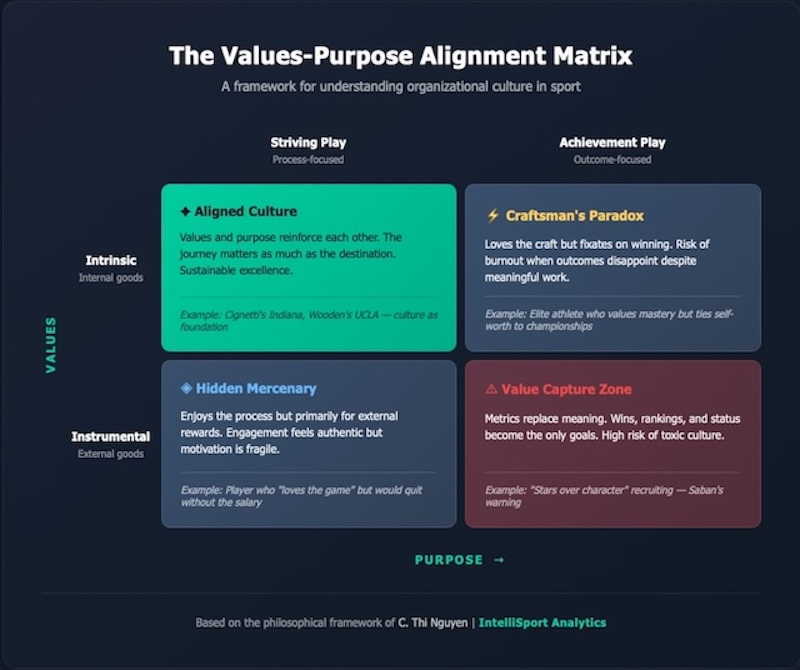
Giannis Antetokounmpo articulated this tension perfectly when asked if his season was a "failure" after Milwaukee's 2023 playoff exit without a championship. His response is worth watching in full, but he explained Michael Jordan lost before he won. That doesn't make those seasons failures. The premise that a season without a title equals failure reflects achievement play thinking—and misses what makes the pursuit meaningful.

But what does this all mean in practice? Let’s turn to the GOAT of college football, Coach Saban.
What Alignment Looks Like in Practice
On Monday this week, the University of Indiana won its first National Football Championship. An unlikely turn-around for a team steeped in historical mediocrity, including the worst record among power conference teams just two years prior. Led by the unflappable head coach Curt Cignetti, and 2025 Heisman Trophy winning quarterback Fernando Mendoza, Indiana demonstrated what is possible when there is a clear alignment between values and purpose. They accomplished this without a top-tier NIL war chest or five-star recruits.
How? Clear expectations. Coaches tuck in their shirts. Players are required to have strong handshakes. These details echo John Wooden's insistence that UCLA players learn to tie their shoes properly—because mastering basics creates the foundation for excellence.
This is culture as operational philosophy, not just aspiration.
Nick Saban, arguably the greatest college football coach in history, put it directly:
"We never looked at how many stars a guy had. Because I think what you have to do is look at who is giving out the stars. They don't know their a$$ from a handful of sand when it comes to what a football player is... It's culture over system. If you don't have a good culture, you are never going to execute the system no matter how good it is."
Saban's insight cuts to the core behind IntelliSport’s purpose and what our work seeks to address: the gap between what organizations say they value and how they actually operate. Star ratings are value capture in action—a simplified metric replacing nuanced evaluation of character, coachability, and fit. Culture, by contrast, is the lived expression of aligned purpose and values. It can't be bought through NIL spending or recruited through rankings. It must be built through leaders who understand the difference between intrinsic and instrumental values, and who choose striving over mere achievement. The question facing every sports organization isn't whether you have a mission statement—it's whether your daily decisions reflect it.
At IntelliSport Analytics
We believe strong culture is not a happy accident—it's the product of deliberate, informed choices. With our tailored approach to people analytics, we help teams and organizations bring clarity to their culture and provide the tools to shape it strategically.